Good morning, friends.
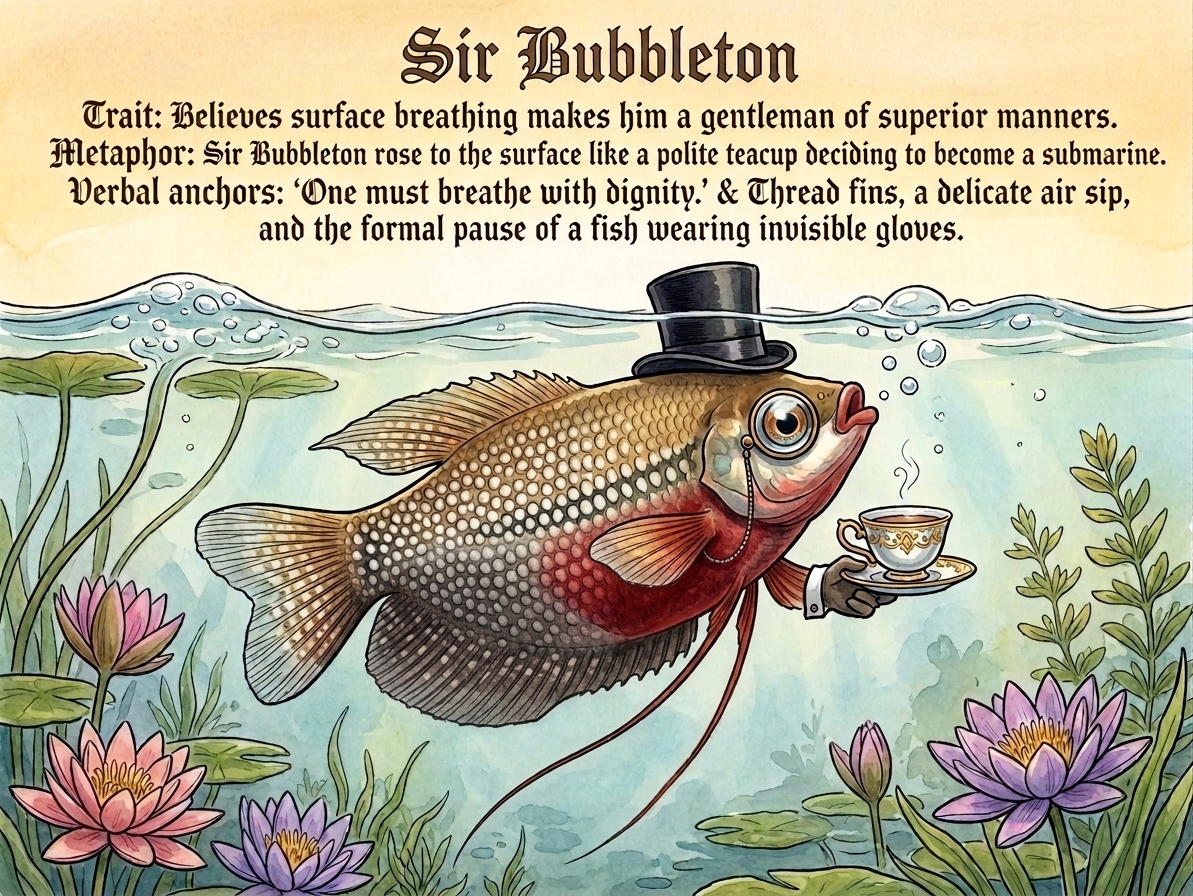
I have just returned from the surface. I rose — as I always do — in the slow, unhurried manner of a gourami who understands that there is no emergency worth arriving at untidily.
My thread fins went first. They are long and pale and rather elegant, my thread fins, like the antennae of a creature who has decided that the world deserves a gentle warning before he arrives in it. They drifted ahead of me through the warm water, parting the little green ripples, announcing: a gentleman approaches. Please arrange yourselves.
Then I rose. And at the surface, with the precise and unhurried ceremony of a creature who has done this ten thousand times and finds it no less important for that — I took a breath. A small breath. A careful breath. The kind of breath that sounds, from below, like the very polite closing of a very small door.
One must breathe with dignity.
✦ ✦ ✦
Now. I am aware that some of you — particularly the younger readers, or any passing neon tetras who have pressed their small faces against this page — may be wondering why a fish goes up to breathe air at all.
Fair question. Excellent question. The sort of question that would earn full marks in any decent biology examination. Allow me to explain.
I am a gourami. (Goo-RAH-mee. Say it slowly. It has a lovely sound, like the beginning of a small symphony.) And inside my head — just above my gills, in a cozy little chamber that most fish do not have — there is something called a labyrinth organ.
(Labyrinth, by the way, means maze. Which is fitting. There is nothing straightforward about being a gourami.)
My labyrinth organ is a folded, twisting chamber full of fine, thin tissue, rather like a very small crumpled handkerchief made of the most delicate possible material. And what this chamber does — what it does magnificently, daily, without any fuss or complaint — is pull oxygen directly from the air I gulp at the surface, and send it into my blood.
I breathe like a fish. And also like a lord.
This is because my ancestors — fine gouramis, every one of them — lived in warm, shallow rice paddies and slow jungle streams in the tropics. Lovely places, I am told. Very fragrant. Not a great deal of oxygen dissolved in the water, however. Rather warm. A little soupy, if one is being honest.
And so, over millions of years, my family evolved a solution. We grew an extra breathing room.
The labyrinth organ means I do not need the water to have much oxygen in it. I can go up, take a breath, and carry on. I find this very civilised. More civilised, in fact, than relying entirely on what the water happens to provide.
(A point which I will not, in the interests of diplomacy, press too far in the direction of certain large-mouthed cichlids who cannot do the same.)
✦ ✦ ✦
Now, some creatures compare surface-breathing to tea time. I understand the impulse. There is a rising quality to it. A ceremony. One goes up, one takes a moment, one comes down refreshed. But I must correct this impression, gently and firmly and with all the warmth at my disposal.
Tea time, my friends, is a choice.
One may skip tea time. It is not ideal. It is, I would argue, inadvisable, and it will certainly affect one's outlook by mid-afternoon. But one will not, as such, perish.
My surface breath is not a choice.
It is a necessity, wearing the very finest coat it owns. If I cannot reach the surface — if the tank lid is sealed too tightly, or if something large and inconsiderate is blocking the way — I am in genuine difficulty. My gills do take some oxygen from the water. But they cannot take enough. The labyrinth is not decorative. The labyrinth works.
I breathe at the surface because I must. I breathe at the surface beautifully because I can. There is a difference, and I think it is an important one.
✦ ✦ ✦
Now. My crumpets have arrived.
This is the moment in the entry where I must pause and address the younger human readers directly, because I understand that some of you have made a face. That particular face — a small downward arrangement of the nose, as if something in the kitchen has gone slightly off.
I saw you.
That face, friends, was made at the word crumpets. Specifically — I suspect — at the fact that my crumpets are made of worms. (Bloodworms, to be precise. Small, red, wriggly, excellent. Frozen for freshness, delivered by Yechiel's careful hand. Quite the finest thing on the menu, if one knows what to look for.)
Your crumpet is a small round bread with holes in it. You put butter on it. Sometimes jam. My crumpet is a small red worm, full of protein, perfectly sized, gently wriggling in the current as it drifts past my thread fins. Your crumpet is not, if I may say, doing anything interesting. Mine is making a genuine effort.
And when we fish encounter something truly excellent — a particularly fine worm, a well-placed algae wafer, a bloodworm that has arrived at exactly the correct temperature — we do not say, as I believe humans say, "Rather good."
We say: “Good cooly fellow.”
It is our way. It means: this thing is correct. This thing has met the standard. This thing deserves acknowledgement, not celebration, because the properly excellent thing arrives quietly, does its job, and asks for no fuss.
✦ ✦ ✦
I had nearly finished my crumpet — I was, in fact, on the final half of the final worm — when there came, from somewhere below and to the left, a familiar sound.
Clik. Clik-clik. Clik-clik-clik-clik-clik.
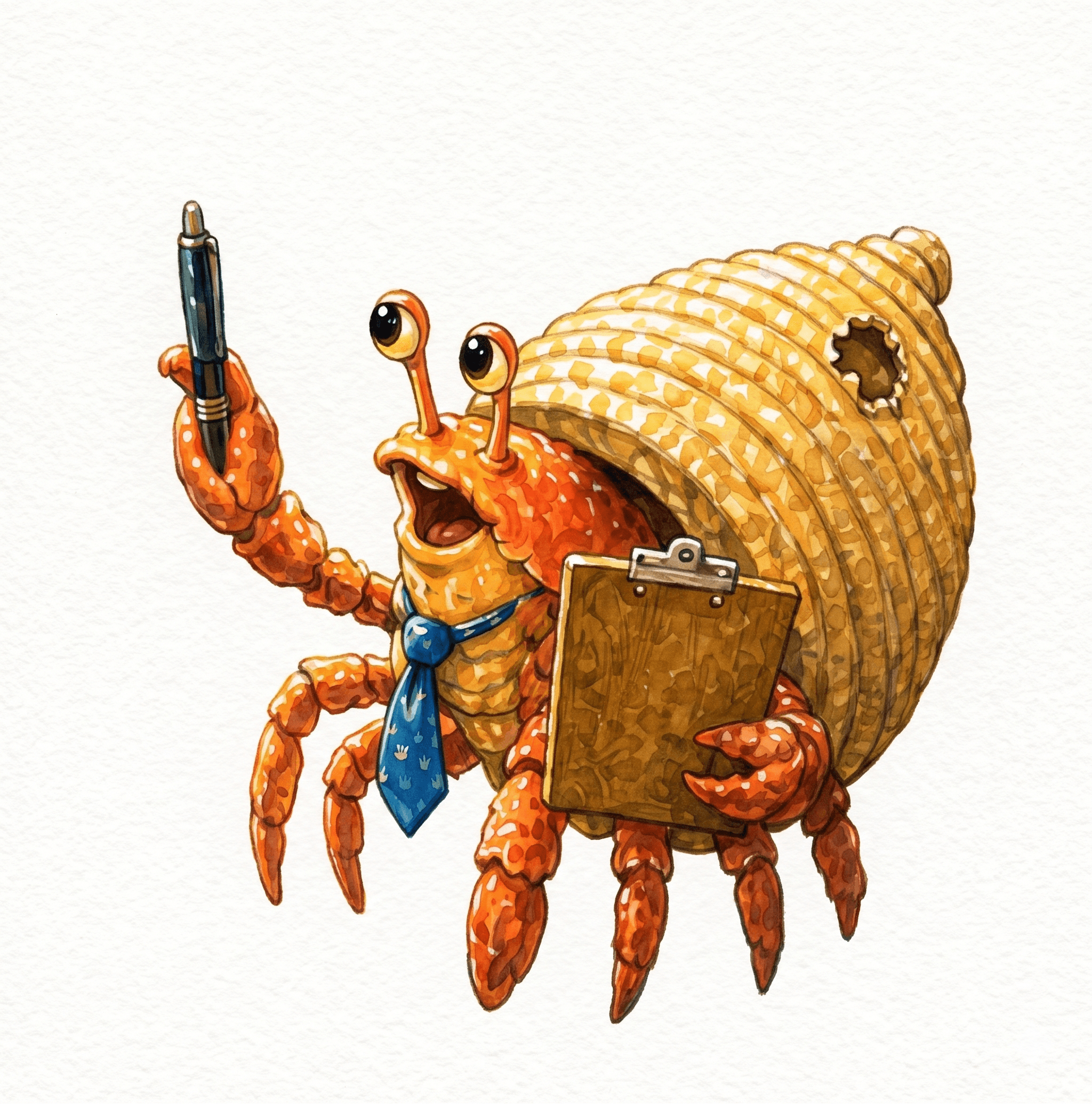
Pinchy the Hermit Crab does not, as a rule, move fast. He moves at the speed of a creature who is evaluating everything in his path for potential value as future property. He taps. He considers. He pronounces. He taps again.
He shot past my lily pad like a small armored trolley with a destination and no time for opinions about the destination. His shell — the spiral one with the slightly chipped lip, which he has been meaning to upgrade for three seasons now — was tucked close to his body. He did not look up. He did not tap. He did not say "Good shell, terrible location," which is what Pinchy says about almost everything, including, on one memorable occasion, his own reflection.
He simply clik-clik-cliked past me at a pace that I can only describe as purposeful, and disappeared around the far side of the bogwood.
Egad.
Only last Tuesday, I observed Pinchy sharing an algae wafer with Plecy near the overflow pipe. Plecy, for those who have not had the pleasure, is a plecostomus — very large, very armored, very methodical. He eats algae in slow, even, dedicated rows, like a fellow painting a very long fence and quite pleased about it.
The algae wafer in question also had a spike — a bristle, technically. And there sat Pinchy, small claws working away at his portion with the measured enjoyment of a creature at a rather good lunch, and there sat Plecy, rasping away at his portion with what I can only describe as contented professionalism. Two very different animals. Sharing a meal. Not discussing it. Not announcing it. Quite civilised, I thought, and I still think.
So why — I asked the surface, as I rose for my second breath of the morning — why was Pinchy running?
The surface gave me no answer. Only a small, precise, polite sip of air.
One must breathe with dignity. Even when one cannot, for the moment, explain the neighbours.
✦ ✦ ✦
I shall watch. I shall observe.
I shall rise to the surface at regular intervals, as is biologically necessary, and I shall do so in the proper manner, thread fins first, without splash, without fuss, without making a spectacle of something that is, after all, simply the art of staying alive.
I shall take my breath.
And I shall keep one eye, as I do, on the bogwood.
Something is happening around that corner. I feel it in my labyrinth.
Until next time, friends.
— Sir Bubbleton the Gourami
Resident of the Greenhouse, third lily pad from the left
Gentleman of the Surface
Retired Compère, available for formal occasions
“Slow, my friend, slow — the water will change with you.”
— Yechiel's Fishery Farm